
The view from the Worminghall home office window – January 24th 2012!
This is a first for me but certainly not for others; Siskin ( Carduelis spinus - http://www.rspb.org.uk/wildlife/birdguide/name/s/siskin/index.aspx ) – pair at the garden feeders
Tuesday, January 24, 2012


Saturday, December 31, 2011
Rushbeds Wood & Lapland Farm
With the blessing of the family I enjoyed an end of year walk around Rushbeds Wood and Lapland Farm (http://www.bbowt.org.uk/content.asp?did=23527).
Given the time of year and the fact that it was late afternoon by the time I arrived, neither the Wood nor the fields were packed with wildlife. However, 18 bird species were seen and identified, and 20+ gulls (Larus sp.) we're seen overflying the reserve but not identified. I am useless with gulls so need to get some lessons!! Of particular note were 2 Raven (Corvus corax). All the birds (excluding the gulls) were recorded in BirdTrack (http://www.bto.org/volunteer-surveys/birdtrack).
Other wildlife sightings were limited to Grey Squirrel (Sciurus carolinensis) and evidence of European Mole (Talpa europaea) activity.
Friday, June 17, 2011
The view from the Worminghall home office window - June 17th 2011!
This is a first for me but certainly not for others; Great spotted woodpecker (Dendrocopos major) – pair feeding juvenile with peanuts from the neighbor’s garden feeder. I will get my feeders up today!
Wednesday, June 15, 2011
The view from the Worminghall home office window - June 15th 2011!
Blackbird (Turdus merula) – a pair feeding young and one juvenile.
Blue tit (Cyanistes caeruleus) – 1
Great tit (Parus major) – 1
Song thrush (Turdus philomelos) – 1 in full song
Wren (Troglodytes troglodytes) – at least 2
Great spotted woodpecker (Dendrocopos major) – 1 briefly in the neighbor’s garden
Red kite (Milvus milvus) – 1
House sparrow (Passer domesticus) – at least 4
Jackdaw (Corvus monedula) – 2 or 3 calling and flying through
Woodpigeon (Columba palumbus) - 2
Blue tit (Cyanistes caeruleus) – 1
Great tit (Parus major) – 1
Song thrush (Turdus philomelos) – 1 in full song
Wren (Troglodytes troglodytes) – at least 2
Great spotted woodpecker (Dendrocopos major) – 1 briefly in the neighbor’s garden
Red kite (Milvus milvus) – 1
House sparrow (Passer domesticus) – at least 4
Jackdaw (Corvus monedula) – 2 or 3 calling and flying through
Woodpigeon (Columba palumbus) - 2
Saturday, May 14, 2011
Rushbeds Wood - Buckinghamshire
I enjoyed a short walk in Rushbeds Wood today. The weather was not so good with about 95% cloud cover, a moderate wind and, when compared with recent weeks, a ‘cool’ temperature of 17°C.
Birds:
19 bird species were seen and records of them were loaded to BirdTrack (http://www.bto.org/volunteer-surveys/birdtrack). There were no species of great note seen during this visit; though, I did get some close views of a ♀ Chaffinch (Fringilla coelebs) collecting nest lining material. I also recorded on my Blackberry a ♂ Blackbird (Turdus merula) in full song with a Chiffchaff (Phylloscopus collybita) providing the backing track!
Butterflies:
Just 2 Speckled Wood (Pararge aegeria) were noted. I did obtain this nice photograph of the first of them.

Other insects:
A single Hornet (Vespa crabro) was on the wing, plus I photographed the following moth species.

I think this is a Cream Wave (Scopula floslactata); however, I will ask the iSpot (http://www.ispot.org.uk/frontpage) community to confirm that.
Flora:
I took the following pictures:


See http://philcoles-naturalhistoryblog.blogspot.com/ for photographs and notes.
Birds:
19 bird species were seen and records of them were loaded to BirdTrack (http://www.bto.org/volunteer-surveys/birdtrack). There were no species of great note seen during this visit; though, I did get some close views of a ♀ Chaffinch (Fringilla coelebs) collecting nest lining material. I also recorded on my Blackberry a ♂ Blackbird (Turdus merula) in full song with a Chiffchaff (Phylloscopus collybita) providing the backing track!
Butterflies:
Just 2 Speckled Wood (Pararge aegeria) were noted. I did obtain this nice photograph of the first of them.

Other insects:
A single Hornet (Vespa crabro) was on the wing, plus I photographed the following moth species.

Flora:
I took the following pictures:

One of the Brambles (Rubus fruticosus agg.)

Spindle (Euonymus europaeus)
See http://philcoles-naturalhistoryblog.blogspot.com/ for photographs and notes.
Saturday, April 23, 2011
Lea Park, Thame, Oxfordshire
I went back to our pond this morning to check the exuviae of the Coenagrionidae damselflies that I noted yesterday. This time I found and photographed a couple in immature adults. Though these were immature insects I think, from checking out my field guide, that they are Large Red Damselflies (Pyrrhosoma nymphula). However, I am by no means sure so will check with the folks on iSpot to see what they think!


Also noted that the tadpoles of the Common Frogs (Rana temporaria) are maturing rapidly in our wonderful spring sunshine!

Friday, April 22, 2011
Lea Park, Thame, Oxfordshire
The pond at home is very popular with the local Honey Bees (Apis mellifera). I am not sure where their nest is located (certainly not in our garden); however, there is a constant stream of the bees coming to the pond to drink.

While watching the bees I noticed many exuviae of Coenagrionidae damselflies. I am not sure to what species they belonged to as only one adult was seen and then only for a very short time. However, that brief view convinced me that the exuviae were from one of the blue/black Coenagrionidae.


Honey Bees (Apis mellifera)
While watching the bees I noticed many exuviae of Coenagrionidae damselflies. I am not sure to what species they belonged to as only one adult was seen and then only for a very short time. However, that brief view convinced me that the exuviae were from one of the blue/black Coenagrionidae.


Exuviae of Coenagrionidae damselflies
Saturday, March 26, 2011
Lea Park, Thame, Oxfordshire
Garden watch – a bit disappointed with yesterday as I was indoors working when I should have been out in the wonderful weather in woods or on the hills watching spring wildlife! However, I did spot a few things around the garden; lots of bees (Bombus sp.), some new frog spawn in the pond and my first butterfly of the year. It was one of the Nymphalidae; however, I only had a brief view so could not be sure of the species identification. I guess it was either a Small Tortoiseshell (Aglais urticae) or a Peacock (Inachis io).
Friday, February 25, 2011
Lea Park, Thame, Oxfordshire
A first on the garden feeders today – 1 ♂ Reed bunting (Emberiza schoeniclus)!
Sunday, February 06, 2011
Emmington - Oxfordshire
I am always surprised by what you can discover just walking around your local patch; never anything rare but, at anytime of the year, something that sparks your interest and provides enjoyment. Take for example one of my local sites – Emmington. This site is typical lowland framing country in Southern England; a bit of arable land, a diary farm with sheep, hedges and fence lines, plus areas managed for game birds such as the coverts and crop strips, all of those with feeding stations. However, even this site has interest at most times of year as was evident from my walk there today.
The temperature during the walk was a balmy 11°C with 98% cloud and a strong gusty wind from the south west.
The following were of note.
Flora:
Best described as a ‘green shoot’ day! The young green shoots of many plants were breaking through the dead foliage of last year. I was quite excited to see those of one of my favorite plants; Lords-and-Ladies (Arum maculatum).


Some of the hedge lines and covert edges were enlivened by Hazel (Corylus avellana) catkins just opening; though, they did not appear to be dropping pollen yet. Perhaps this was because I could not find any ♀ flowers displaying their red styles.

Close by the village naturalized patches of Snowdrop (Galanthus nivalis) were in full flower.
Birds:
23 species were seen and/or heard and then recorded on BirdTrack (http://www.bto.org/volunteer-surveys/birdtrack). Naturally, nothing scarce for these parts was observed; however, it was good to see my first 2 Yellowhammers (Emberiza citronella) of the year. Also of note, was a flock of Fieldfare (Turdus pilaris), at least 100, plus a flock of c.50 Lapwing (Vanellus vanellus).
Habitat notes:
I wonder what lives here.


I must find out about the fauna and flora that inhabit micro-pools in trees.
The temperature during the walk was a balmy 11°C with 98% cloud and a strong gusty wind from the south west.
The following were of note.
Flora:
Best described as a ‘green shoot’ day! The young green shoots of many plants were breaking through the dead foliage of last year. I was quite excited to see those of one of my favorite plants; Lords-and-Ladies (Arum maculatum).

Lords-and-Ladies (Arum maculatum)

Lords-and-Ladies (Arum maculatum)
Some of the hedge lines and covert edges were enlivened by Hazel (Corylus avellana) catkins just opening; though, they did not appear to be dropping pollen yet. Perhaps this was because I could not find any ♀ flowers displaying their red styles.

Hazel (Corylus avellana)
Close by the village naturalized patches of Snowdrop (Galanthus nivalis) were in full flower.
Birds:
23 species were seen and/or heard and then recorded on BirdTrack (http://www.bto.org/volunteer-surveys/birdtrack). Naturally, nothing scarce for these parts was observed; however, it was good to see my first 2 Yellowhammers (Emberiza citronella) of the year. Also of note, was a flock of Fieldfare (Turdus pilaris), at least 100, plus a flock of c.50 Lapwing (Vanellus vanellus).
Habitat notes:
I wonder what lives here.


Thursday, January 20, 2011
Shirburn Hill - Oxfordshire
I took a short break from work at lunchtime last Tuesday to walk over Shirburn Hill (http://tinyurl.com/4l2obp9). The temperature during the walk varied between 3 & 5°C, with 100% cloud at the start of the walk reducing to 25% cloud cover at the end. I enjoyed the sunny periods with only a light wind!


A rather quiet walk to begin with but as the cloud cover decreased and the sun came out; the wildlife sightings seemed to increase.
The following were of note.
Fungi:
Jew's Ear (Auricularia auricula-judae) growing, as is normal for these parts, on Elder (Sambucus nigra).


Lichen:
I noted some interesting but unidentified species of lichen growing on Common Whitebeam (Sorbus aria). I will share these photographs with the iSpot (http://www.ispot.org.uk/frontpage) community to see if others can identify them.


Birds:
Only 21 species were seen and/or heard and then recorded on BirdTrack (http://www.bto.org/volunteer-surveys/birdtrack). Not a great total; however, I did make two key sightings; 2 Marsh Tit (Poecile palustris), a first for me at this location, and a Raven (Corvus corax). Another first for this site were a couple of Fieldfare (Turdus pilaris). I have seen many over the years next door at Aston Rowant NNR, but none here before!
Mammals:
Some fresh Mole (Talpa europaea) activity was noted on the hill top and at its base; areas of deep soil when compared with the slopes. Rabbit (Oryctolagus cuniculus) were a common sight on this walk as were Grey squirrel (Sciurus carolinensis).
Two species of deer were on the hill; 1 ♀ Fallow deer (Dama dama) was seen and 1 Muntjac (Muntiacus reevesi) was heard barking. However, it was disturbing to see the Fallow deer as this animal had an injured right hind leg as seen from the front. It could not put any weight on that leg and, on a closer view; it appeared to have lost its foot! I could not be sure but that was certainly how it appeared.

Shirburn Hill

Shirburn Hill

The Box Wood (Buxus sempervirens) at Shirburn Hill

The view south down the scarp from Shirburn Hill
The following were of note.
Fungi:
Jew's Ear (Auricularia auricula-judae) growing, as is normal for these parts, on Elder (Sambucus nigra).

Jew's Ear (Auricularia auricula-judae)

Jew's Ear (Auricularia auricula-judae)
Lichen:
I noted some interesting but unidentified species of lichen growing on Common Whitebeam (Sorbus aria). I will share these photographs with the iSpot (http://www.ispot.org.uk/frontpage) community to see if others can identify them.


Birds:
Only 21 species were seen and/or heard and then recorded on BirdTrack (http://www.bto.org/volunteer-surveys/birdtrack). Not a great total; however, I did make two key sightings; 2 Marsh Tit (Poecile palustris), a first for me at this location, and a Raven (Corvus corax). Another first for this site were a couple of Fieldfare (Turdus pilaris). I have seen many over the years next door at Aston Rowant NNR, but none here before!
Mammals:
Some fresh Mole (Talpa europaea) activity was noted on the hill top and at its base; areas of deep soil when compared with the slopes. Rabbit (Oryctolagus cuniculus) were a common sight on this walk as were Grey squirrel (Sciurus carolinensis).
Two species of deer were on the hill; 1 ♀ Fallow deer (Dama dama) was seen and 1 Muntjac (Muntiacus reevesi) was heard barking. However, it was disturbing to see the Fallow deer as this animal had an injured right hind leg as seen from the front. It could not put any weight on that leg and, on a closer view; it appeared to have lost its foot! I could not be sure but that was certainly how it appeared.
Monday, January 10, 2011
Lea Park, Thame, Oxfordshire
A first in the Coles garden this morning; one ♂ Blackcap (Sylvia atricapilla) feeding on a fat ball. What a great start to the work week!
Sunday, January 09, 2011
Rushbeds Wood and Lapland Farm - Buckinghamshire
A Sunday lunchtime walk in Rushbeds Wood and Lapland Farm Nature Reserve (http://www.bbowt.org.uk/content.asp?did=23527). The temperature throughout the walk was between 3 & 4°C with 100% sun. In the shadows frost still lingered and a cold wind slightly moved the tops of the trees.


The Wood and its environs are located in UK National Grid Tetrad SP61S and this visit was focused on completing my late winter visit to that Tetrad for the BTO Bird Atlas 2007-2011 (http://www.bto.org/volunteer-surveys/birdatlas).
The following were of note.
Birds:
Only 21 species were seen and/or heard and then recorded on the BirdAtlas site. Not a great total but I was not expecting a great watching session from the numbers view of point! There were two key sightings; 2 Marsh Tit (Poecile palustris) and, a first for me at this location, a Raven (Corvus corax). Add to that some sustained song from Great Tit (Parus major) and Wren (Troglodytes troglodytes), the walk proved very enjoyable despite the lack of species numbers.
Mammals:
Some fresh Mole (Talpa europaea) activity was noted as were 2 high-seats! I guess, from the presence of the latter, BBOWT (http://www.bbowt.org.uk/default.asp) must be culling deer in the Wood. Certainly the deer severely restrict coppice re-growth which does not benefit woodland fauna and flora which flourish in coppiced areas. It does seem odd to see rifle shooting going on in a nature reserve; however, that is, I guess, what has to be done in regions where deer have no natural predators!

Rushbeds Wood

'Oxbow' in Rushbeds Wood

Rushbeds Wood

Trackbed of the disused Brill Tramway as it runs through Rushbeds Wood (http://en.wikipedia.org/wiki/Brill_Tramway)
The Wood and its environs are located in UK National Grid Tetrad SP61S and this visit was focused on completing my late winter visit to that Tetrad for the BTO Bird Atlas 2007-2011 (http://www.bto.org/volunteer-surveys/birdatlas).
The following were of note.
Birds:
Only 21 species were seen and/or heard and then recorded on the BirdAtlas site. Not a great total but I was not expecting a great watching session from the numbers view of point! There were two key sightings; 2 Marsh Tit (Poecile palustris) and, a first for me at this location, a Raven (Corvus corax). Add to that some sustained song from Great Tit (Parus major) and Wren (Troglodytes troglodytes), the walk proved very enjoyable despite the lack of species numbers.
Mammals:
Some fresh Mole (Talpa europaea) activity was noted as were 2 high-seats! I guess, from the presence of the latter, BBOWT (http://www.bbowt.org.uk/default.asp) must be culling deer in the Wood. Certainly the deer severely restrict coppice re-growth which does not benefit woodland fauna and flora which flourish in coppiced areas. It does seem odd to see rifle shooting going on in a nature reserve; however, that is, I guess, what has to be done in regions where deer have no natural predators!
Sunday, January 02, 2011
Valley of the River Thame near Chearsley - Buckinghamshire
My first walk of the year took me down into the valley of the River Thame near Chearsley (http://tinyurl.com/29adszv). The temperature throughout the walk was 3°C with about 90% thin cloud cover and some weak winter sun.
The following were of note.
Birds:
27 species were seen and/or heard and recorded in BirdTrack (http://www.bto.org/birdtrack/). The key sighting was a small but dispersed flock of Teal (Anas crecca). There were at least 4 individuals but, possibly, 2 or 3 additional birds. Teal have yet to be noted by me on the Thame during the breeding season; so, my assumption is that these were winter visitors to the valley.
Mammals:
Some fresh Mole (Talpa europaea) activity noted where the land appeared just above areas subject to recent flooding.
The following were of note.
Birds:
27 species were seen and/or heard and recorded in BirdTrack (http://www.bto.org/birdtrack/). The key sighting was a small but dispersed flock of Teal (Anas crecca). There were at least 4 individuals but, possibly, 2 or 3 additional birds. Teal have yet to be noted by me on the Thame during the breeding season; so, my assumption is that these were winter visitors to the valley.
Mammals:
Some fresh Mole (Talpa europaea) activity noted where the land appeared just above areas subject to recent flooding.
Sunday, November 28, 2010
Valley of the River Thame near Starveall Farm - Buckinghamshire
I enjoyed a short walk before lunch down into the valley of the River Thame near Starveall Farm (http://cwr.naturalengland.org.uk/Default.aspx?Module=CountryWalkDetails&Site=3570). The temperature at the start was -5°C rising to about 0°C by the time I returned to the car. However, the cloud was thin and the sun was out! It seemed to be much colder in the bottom of the valley.
The following were of note.
Birds:
24 species were seen and/or heard and recorded in BirdTrack (http://www.bto.org/birdtrack/). Of main interest were the large numbers of Thrushes; particularly the abundant Fieldfare (Turdus pilaris) and, to a much lesser extent, Blackbird (Turdus merula). Added to those were small numbers of Redwing (Turdus iliacus), Song thrush (Turdus philomelos) and Mistle thrush (Turdus viscivorus). All these birds were primarily foraging under the hedges and tree lines.
Also notable were Snipe (Gallinago gallinago). One was disturbed, typically, from the river; however, 6 more were found feeding in one of the riverside meadows. This is the largest number of Snipe seen by me at this site.
Finally, a couple of Woodpigeon kills were found; only feathers seen with no carcass evident. See the following photograph.

Mammals:
Some Fresh Mole (Talpa europaea) activity noted, plus 2 Grey squirrel (Sciurus carolinensis) and a sickly Rabbit (Oryctolagus cuniculus).
The following were of note.
Birds:
24 species were seen and/or heard and recorded in BirdTrack (http://www.bto.org/birdtrack/). Of main interest were the large numbers of Thrushes; particularly the abundant Fieldfare (Turdus pilaris) and, to a much lesser extent, Blackbird (Turdus merula). Added to those were small numbers of Redwing (Turdus iliacus), Song thrush (Turdus philomelos) and Mistle thrush (Turdus viscivorus). All these birds were primarily foraging under the hedges and tree lines.
Also notable were Snipe (Gallinago gallinago). One was disturbed, typically, from the river; however, 6 more were found feeding in one of the riverside meadows. This is the largest number of Snipe seen by me at this site.
Finally, a couple of Woodpigeon kills were found; only feathers seen with no carcass evident. See the following photograph.

Some Fresh Mole (Talpa europaea) activity noted, plus 2 Grey squirrel (Sciurus carolinensis) and a sickly Rabbit (Oryctolagus cuniculus).
Friday, November 26, 2010
Murcott Meadows SSSI
Today I had a short break from work for an afternoon walk over Murcott Meadows SSSI (http://tinyurl.com/32muucx). The temperature was about 2°C; however, the cloud was thin and the sun was out! All ground was still frozen in the areas of shade.
The following were of note.
Flora:
Nothing of great interest; however, I did take the following photographs of lichen encrusted Blackthorn (Prunus spinosa). This was a very common sight on the north side of the spinney.


Birds:
17 species were seen and/or heard and recorded in BirdTrack (http://www.bto.org/birdtrack/). Of main interest were good views of Fieldfares (Turdus pilaris) and Redwings (Turdus iliacus), plus small groups of Starling (Sturnus vulgaris) heading towards the Otmoor roost (http://tinyurl.com/39lsnys).
Mammals:
Fresh Mole (Talpa europaea) activity in evidence around the meadow boundaries, plus one Grey squirrel (Sciurus carolinensis) seen.
The following were of note.
Flora:
Nothing of great interest; however, I did take the following photographs of lichen encrusted Blackthorn (Prunus spinosa). This was a very common sight on the north side of the spinney.


Birds:
17 species were seen and/or heard and recorded in BirdTrack (http://www.bto.org/birdtrack/). Of main interest were good views of Fieldfares (Turdus pilaris) and Redwings (Turdus iliacus), plus small groups of Starling (Sturnus vulgaris) heading towards the Otmoor roost (http://tinyurl.com/39lsnys).
Mammals:
Fresh Mole (Talpa europaea) activity in evidence around the meadow boundaries, plus one Grey squirrel (Sciurus carolinensis) seen.
Sunday, November 14, 2010
Aston Rowant NNR (South)
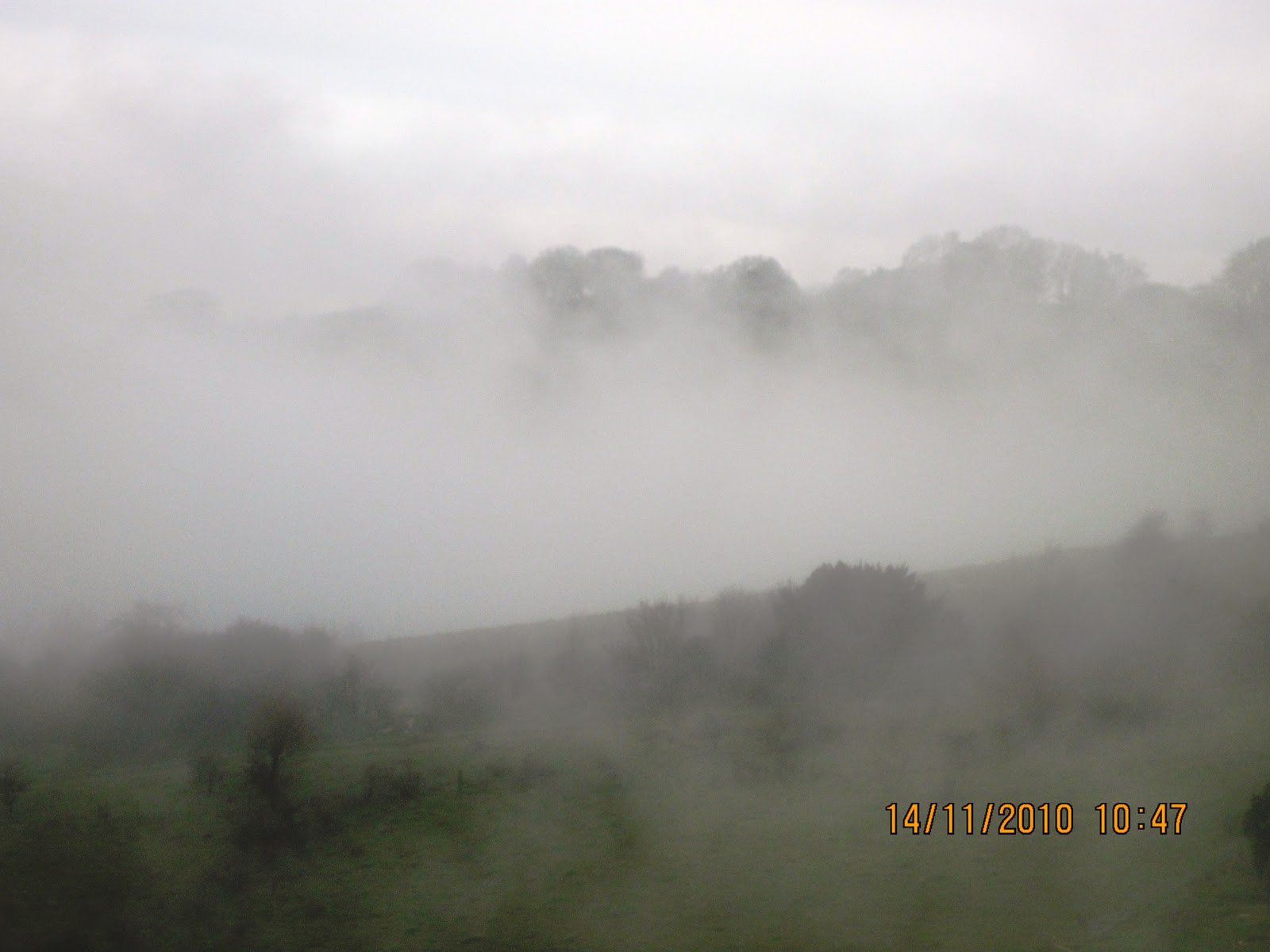
Up in the hills today! A late Autumn (early Winter) walk over Aston Rowant NNR (South). The temperature varied between 6°C and 7°C; it was damp underfoot with mist patches.


The following were of note.
Flora:
I noted that at least 2 spikes of Yellow-wort (Blackstonia perfoliata) were in bud and suspect the flowers would open should the sun ever come out. The stands of Juniper (Juniperus communis) were impressive with some re-generation noted. Finally, the Hazel (Corylus avellana) catkins made a great show and gave a hint that Spring will come after we have lived through the depths of Winter!

Birds:
17 species were seen and/or heard and recorded in BirdTrack (http://www.bto.org/birdtrack/). Not that great but my sightings did include some choice views of three Winter visitors.
• Finch flocks were much in evidence but the best sight was 10+ Brambling (Fringilla montifringilla) feeding around the top of an Ash (Fraxinus excelsior) and a Common Whitebeam (Sorbus aria). Not a particularly rare species but one not often observed by me.
• Fieldfares (Turdus pilaris) heard plus good views of Redwing (Turdus iliacus) obtained.
Mammals:
5+ Fallow deer (Dama dama) noted and 2 Roe deer (Capreolus capreolus) seen.




The following were of note.
Flora:
I noted that at least 2 spikes of Yellow-wort (Blackstonia perfoliata) were in bud and suspect the flowers would open should the sun ever come out. The stands of Juniper (Juniperus communis) were impressive with some re-generation noted. Finally, the Hazel (Corylus avellana) catkins made a great show and gave a hint that Spring will come after we have lived through the depths of Winter!

Juniper (Juniperus communis)
Birds:
17 species were seen and/or heard and recorded in BirdTrack (http://www.bto.org/birdtrack/). Not that great but my sightings did include some choice views of three Winter visitors.
• Finch flocks were much in evidence but the best sight was 10+ Brambling (Fringilla montifringilla) feeding around the top of an Ash (Fraxinus excelsior) and a Common Whitebeam (Sorbus aria). Not a particularly rare species but one not often observed by me.
• Fieldfares (Turdus pilaris) heard plus good views of Redwing (Turdus iliacus) obtained.
Mammals:
5+ Fallow deer (Dama dama) noted and 2 Roe deer (Capreolus capreolus) seen.
Sunday, October 10, 2010
Thame Valley Shabbington - Buckinghamshire and Oxfordshire border
A lunchtime walk along the River Thame on the Buckinghamshire bank downstream of Shabbington. I started the walk at 11:45 and finished around 14:00. 15°C and 90% cloud at the start but rapidly changing to 100% sun and 19°C.
The following were of note.
Insects:
Butterflies – one large unidentified insect flying at a distance and one White seen; the latter possibly a Small or Green-veined White (Pieris rapae or Pieris napi). However, I did get firm ids on two other butterflies – 1 ♂ Brimstone (Gonepteryx rhamni) and 1 Red Admiral (Vanessa atalanta).
Dragonflies – I think I had a Migrant Hawker (Aeshna mixta) though too distant to id with certainty and could not obtain a record shot. However, I did see some Common Darter (Sympetrum striolatum) with at least one pair in tandem and ovipositing.

Flora:
The following were in flower:


Birds:
Good views of the following were obtained:
• Mute swan (Cygnus olor) – the winter flock had 4 individuals in it.
• Redshank (Tringa tetanus) – 1 disturbed from the river; white pointed rump and broad edge to trailing wing edges very diagnostic. This is a first for me at any of my River Thame sites!
• Buzzard (Buteo buteo) – 2;
• Red kite (Milvus milvus) – 5+;
• Grey heron (Ardea cinerea) – 1;
• Lapwing (Vanellus vanellus) – flock of 25 to 30 flying over.
The following were of note.
Insects:
Butterflies – one large unidentified insect flying at a distance and one White seen; the latter possibly a Small or Green-veined White (Pieris rapae or Pieris napi). However, I did get firm ids on two other butterflies – 1 ♂ Brimstone (Gonepteryx rhamni) and 1 Red Admiral (Vanessa atalanta).
Dragonflies – I think I had a Migrant Hawker (Aeshna mixta) though too distant to id with certainty and could not obtain a record shot. However, I did see some Common Darter (Sympetrum striolatum) with at least one pair in tandem and ovipositing.

♂ Common Darter (Sympetrum striolatum)
Flora:
The following were in flower:

Water Forget-me-not (Myosotis scorpioides)

Not sure about this one! I am checking with the community on iSpot.
Input from the iSpot community suggests:
Comment from allrounder: This looks from the picture like Great Yellow-cress and as the scientific name suggests is found in and by fresh water. Your picture shows a plant with a stout stem, lanceolate, toothed leaves and the fruits are oval with a style. All indicators of Great Yellow-cress. This plant is described as only locally common so a good find.
Input from the iSpot community suggests:
Great Yellow-cress (Rorippa amphibia)
Comment from allrounder: This looks from the picture like Great Yellow-cress and as the scientific name suggests is found in and by fresh water. Your picture shows a plant with a stout stem, lanceolate, toothed leaves and the fruits are oval with a style. All indicators of Great Yellow-cress. This plant is described as only locally common so a good find.
Birds:
Good views of the following were obtained:
• Mute swan (Cygnus olor) – the winter flock had 4 individuals in it.
• Redshank (Tringa tetanus) – 1 disturbed from the river; white pointed rump and broad edge to trailing wing edges very diagnostic. This is a first for me at any of my River Thame sites!
• Buzzard (Buteo buteo) – 2;
• Red kite (Milvus milvus) – 5+;
• Grey heron (Ardea cinerea) – 1;
• Lapwing (Vanellus vanellus) – flock of 25 to 30 flying over.
Thursday, October 07, 2010
Lea Park, Thame, Oxfordshire
A first for my garden in Thame! 2 Raven (Corvus corax) flying over and heading south.
Sunday, October 03, 2010
Emmington - Oxfordshire
Today was not the best of days for a wildlife walk; however, as I had not been on one since August it was a must to get out into the field! I spent about 2 hours from 10:50 walking the footpaths around Emmington. The weather was pleasant to begin with at 15°C with light rain; however, the rain became heavier and the wind stronger by the time I got back to the car.
The following were of note.
Insects:
Hornet (Vespa crabro) – At least three where flying close to Great Covert, with one amongst the sunflowers in a strip planted as game cover.
Fungi:
Three interesting species of fungi were seen during the walk; 2 in Down Covert on tree trunks and one on Ash (Fraxinus excelsior). I am no expert at identifying fungi so I have loaded the following photographs to iSpot (http://www.ispot.org.uk/frontpage) to seek id support from the community. I will update the blog if ids provided.
The iSpot community did not let me down. Two ids provided plus a possible id. See the captions under the relevant photographs for the species identifications.


Flora:
The following were in flower:
• White Dead-nettle (Lamium album);

• Red Clover (Trifolium pretense);

• Common Field Speedwell (Veronica persica);

• 2 species of Umbelliferae.


• House martin (Delichon urbica) – small flocks;
• Swallow (Hirundo rustica) - small flocks;
• Buzzard (Buteo buteo) – at least 3 with one harassed by corvids;
• Red kite (Milvus milvus) – 6+;
• Kestrel (Falco tinnunculus) – 2;
• Skylark (Alauda arvensis) – calling from recently drilled fields;
• Chiffchaff (Phylloscopus collybita) – 2 calling;
• Stock dove (Columba oenas) – possible the largest flock I have ever seen; 30+ individuals.
Mammals:
• 1 Brown hare (Lepus europaeus);
• Grey squirrel (Sciurus carolinensis) – evidence that they are feeding on maze hobs picked from the strips sown as game cover. Feeding stations found in Down Covert.

The following were of note.
Insects:
Hornet (Vespa crabro) – At least three where flying close to Great Covert, with one amongst the sunflowers in a strip planted as game cover.
Fungi:
Three interesting species of fungi were seen during the walk; 2 in Down Covert on tree trunks and one on Ash (Fraxinus excelsior). I am no expert at identifying fungi so I have loaded the following photographs to iSpot (http://www.ispot.org.uk/frontpage) to seek id support from the community. I will update the blog if ids provided.
The iSpot community did not let me down. Two ids provided plus a possible id. See the captions under the relevant photographs for the species identifications.

Pleurotus sp. poss. either P. ostreatus or P. cornucopiae. Need to revisit site to get improved images and images of the stipe. In P. cornucopiae the lamellae run down the stipe and criss-cross over each other to form a distinctive diamond pattern.

Pleurotus sp. poss. either P. ostreatus or P. cornucopiae. Need to revisit site to get improved images and images of the stipe. In P. cornucopiae the lamellae run down the stipe and criss-cross over each other to form a distinctive diamond pattern.

Pholiota adiposa

Pholiota adiposa

Silverleaf Fungus (Chondrostereum purpureum) on Ash (Fraxinus excelsior)
Flora:
The following were in flower:
• White Dead-nettle (Lamium album);
• Red Clover (Trifolium pretense);

• Common Field Speedwell (Veronica persica);

• 2 species of Umbelliferae.


Birds:• House martin (Delichon urbica) – small flocks;
• Swallow (Hirundo rustica) - small flocks;
• Buzzard (Buteo buteo) – at least 3 with one harassed by corvids;
• Red kite (Milvus milvus) – 6+;
• Kestrel (Falco tinnunculus) – 2;
• Skylark (Alauda arvensis) – calling from recently drilled fields;
• Chiffchaff (Phylloscopus collybita) – 2 calling;
• Stock dove (Columba oenas) – possible the largest flock I have ever seen; 30+ individuals.
Mammals:
• 1 Brown hare (Lepus europaeus);
• Grey squirrel (Sciurus carolinensis) – evidence that they are feeding on maze hobs picked from the strips sown as game cover. Feeding stations found in Down Covert.

Subscribe to:
Posts (Atom)
